Blog
Ending food insecurity

One of the more remarkable gains in this country has been the reduction, over the last 100 years, in the number of people living in poverty. The definition of poverty has evolved over this time frame, but it generally means that a family could not afford a minimum “basket of necessities” such as food, shelter, medical care and clothing.
Almost 50% of Americans (adults and kids) lived in poverty in 1939. In 2025, that number was about 10%. The gains have been particularly impressive for Black citizens. The poverty level dropped from 85% to 18% in the same time frame.
There are lots of reasons for these gains – Medicaid, various social programs such as food stamps, more economic options for women and people of color and an overall growth in the economy.
The country should be proud of the gains, but we would be wrong if we thought that the problem of people being able to meet their basic needs has been solved. One area that still needs significant attention is food insecurity.
My wife and I donate money and time to Open Table, a local food bank. I attended their semi-annual meeting in which they discussed their plans, programs and impact.
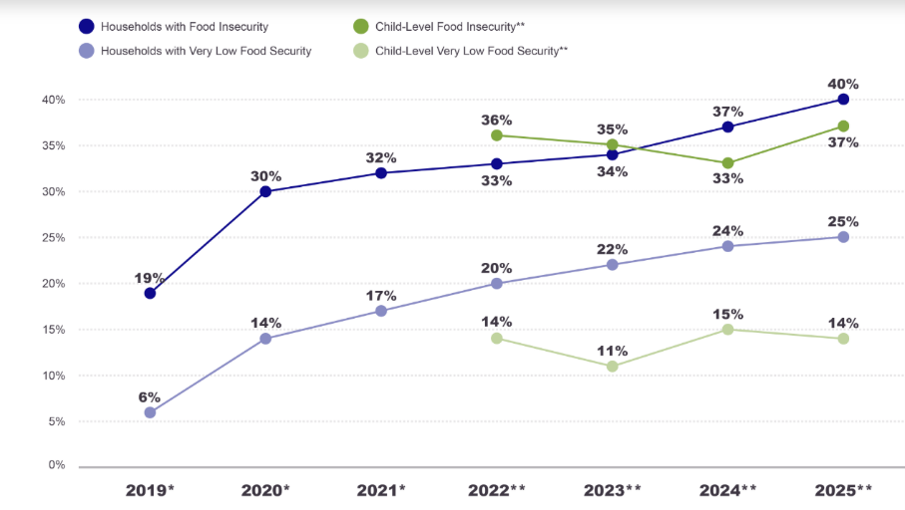
Massachusetts has the highest median annual houshold income of any state – $104,800. And yet 40% of the state’s residents experience food insecurity. Food insecurity means that a family or person has uncertain or limited access to enough food due to financial or resource constraints. It doesn’t necessarily mean constant hunger.
Very low food security is more severe and usually involves skipping meals and reducing intake.
While poverty levels have decreased, there has been an alarming increase in the number of people in the state who are food insecure or who have very low food security. This increase, which can be seen in the graph in this post, is due to reductions in federal support and significant increases in the cost of living in the state (which means that housing and medical expenses, for example, crowd out the amount of momey available for food.)
The consequences are far ranging. In food insecure households, 68% of adults reported going without medications, 33% skipped medical care and 47% skipped dental care. For the kids in food insecure households, 63% reported going without medications, 53% skipped medical care, and 27% skipped dental care.
I give the Open Table staff, board and volunteers a lot of credit in their efforts to tackle this. In 2025, they distributed 976,427 pounds of food to 8,000 people who live in 21 cities. They are joined by their colleagues in about 50,000 food banks across the US. As a sign of the persistent, and growing problem of food insecurity, this number is an increase from 33,000 banks in 2000.
It is easy to forget that in this country of extraordinary plenty, and despite our progress in tackling poverty, there are many people who are struggling to get by.