Blog
Making leftovers

In high school and college, I had part-time jobs as a cook. I worked on the graveyard shift at a local 24-hour coffee shop, and I was a “chef” at Pizza Hut.
Those experiences and my current skills at making macaroni and cheese and hot dogs for grandkids have enabled me to declare myself a culinary wizard.
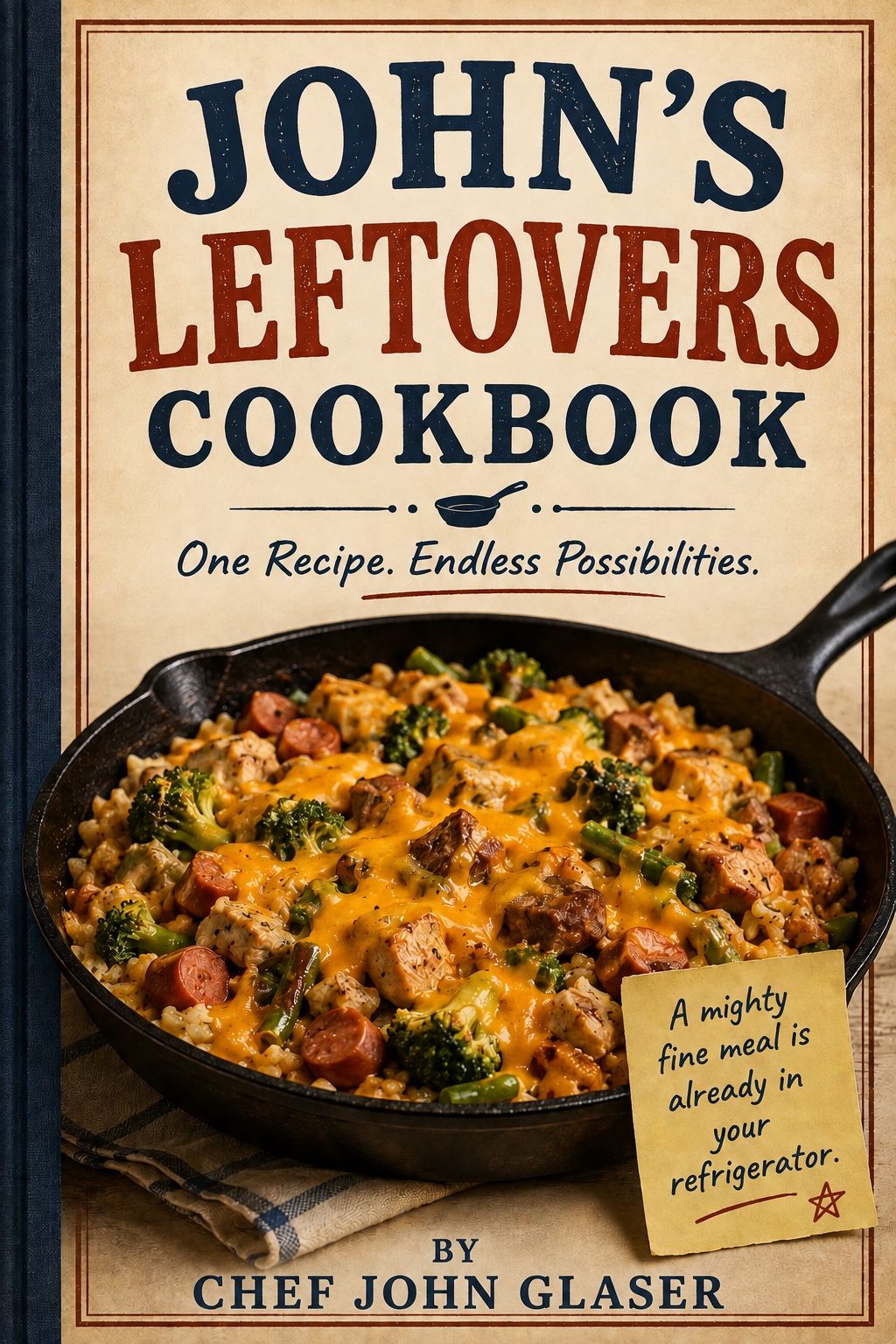
A while back I had an idea that I would write “John’s Leftovers Cookbook.” A sure-fire approach to rustling up some tasty leftovers. The cookbook has only one recipe (that’s all you need to deal with leftovers) which means that anyone can easily make a very fine meal based on whatever is in the refrigerator.
The outline for the cookbook is below.
John’s Leftovers Cookbook
One Recipe. Endless Possibilities.
By Chef John Glaser
A Note from the Author
Cooking does not have to be complicated.
You do not need exotic ingredients. You do not need a sous vide machine. You do not need to know what a sous vide machine is.
You need a skillet, some leftovers, a huge glob of cheese, Worcestershire or hot sauce and confidence.
This cookbook is the pinnacle of my cooking experience and skill. The book fills a niche long neglected by existing cookbooks – what do I do with leftovers?
The Recipe
- Heat oil in a big skillet.
- Add some leftover meat — chicken, steak, or hot dogs.
- Add some leftover starch — rice or potatoes.
- Add some leftover vegetables — broccoli, green beans, or asparagus.
- Heat and stir from time to time.
- While stirring, add a huge glob of cheddar cheese.
- Sprinkle with Worcestershire sauce or hot sauce.
- Serve.
Quantities are intentionally unspecified. Trust yourself.
Chef John’s Notes
Serves: Depends on how much was left over.
Preparation time: Almost none. You might have to chop up an ingredient or two.
Cooking time: Until it’s hot.
Difficulty: If you can find the skillet and turn on the stove, you can make this.
Wine pairing: Whatever is already open.
Substitutions: Encouraged.
Most important culinary principle: When in doubt, add more cheese.
About the Author
John is a cooking maven and a pioneer in the field of leftover cuisine.
Rejecting the unnecessary constraints of measurements, recipes, planning, and grocery shopping, he developed a culinary philosophy based on a simple question – “What’s in the refrigerator?”
John’s Leftovers Cookbook represents the culmination of his culinary career. It is likely to be his last cookbook; it is hard to imagine that a simpler and tastier meal exists than a dinner of leftovers prepared using the recipe in this book.